
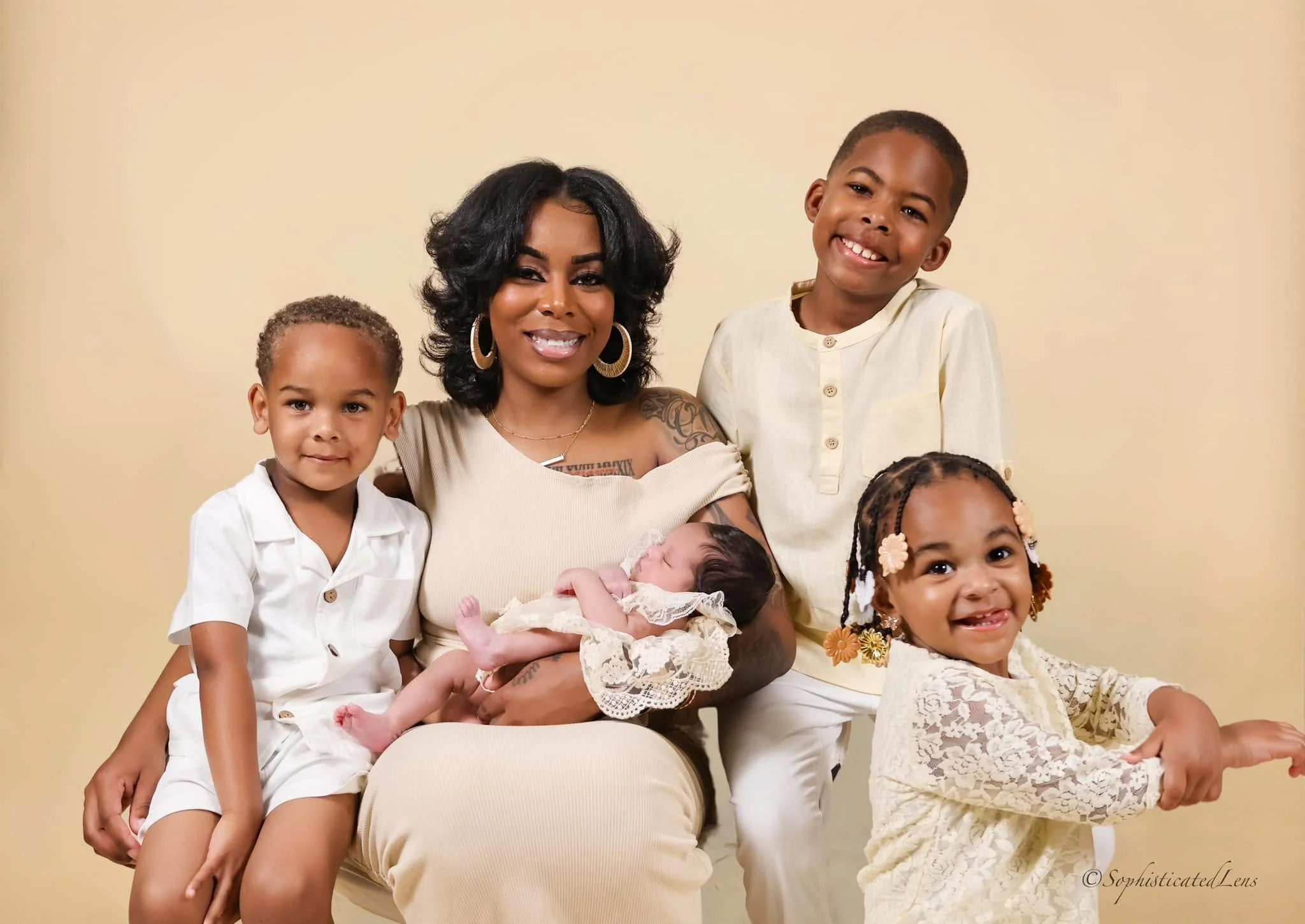
You would think having more children would make motherhood easier.
I thought experience would make me better prepared.
By the time I had my fourth child, I had already been through pregnancy, newborn stages, sleepless nights, tantrums, potty training, school, sickness, picky eating, sibling arguments and all the other things that come with raising children.
I had done this before.
Four times, actually.
What I didn’t realize was that having four children doesn’t mean you’ve done the same thing four times.
It means you’ve been introduced to four completely different people.
My children have different personalities, different strengths, different struggles and different ways of communicating what they need from me.
What works for one doesn’t necessarily work for another.
One child might need me to push them.
Another needs reassurance.
One wants to tell me every detail of their day.
Another might give me three words and consider the conversation complete.
One can handle something independently.
Another needs me right beside them.
And somehow, I’m supposed to meet all of those needs while also being a wife, working from home, running a household and trying to remember why I walked into the kitchen in the first place.
Motherhood can be a lot.
And lately, I’ve been thinking about that more than usual.
My youngest has brought a completely different experience to motherhood.
Before we had a diagnosis, there were things we noticed.
There were differences in the way she communicated and interacted with the world. Things that didn’t necessarily seem huge on their own, but when we started putting them together, we knew we needed to understand more.
We eventually had her evaluated.
Now we know that she is autistic.
Getting that answer gave us information we needed, but it didn’t suddenly turn me into an expert.
It didn’t give me a perfect plan.
It didn’t erase the uncertainty that comes with raising a child whose needs may look different from what you expected.
It simply gave us a place to start.
And we’re starting.
We’re learning.
We’re paying attention.
We’re figuring out what helps her communicate, what makes things easier for her, what she enjoys and what she needs from us.
At the same time, life hasn’t stopped for everyone else.
That’s something I think people can forget about when a family receives a diagnosis.
The rest of the family is still there.
I still have three other children who need their mom.
They have their own personalities, their own schoolwork, their own emotions, their own interests and their own moments when they just want me.
They shouldn’t have to become more independent because one of their siblings needs additional support.
And my youngest shouldn’t have to need less because her siblings need me too.
So I’m constantly trying to find the balance.
Sometimes I do a good job.
Sometimes I don’t.
There are days when I feel like I gave everybody what they needed.
There are other days when I feel like I spent the entire day putting out little fires and somehow still didn’t accomplish everything I needed to.
I’m also working from home, which has been both a blessing and a challenge.
People hear “work from home” and sometimes imagine that it means I have plenty of flexibility.
I do have flexibility in some ways.
But flexibility doesn’t mean I have unlimited capacity.
There are still work responsibilities.
There are still deadlines.
There are still meetings and messages and things that need to be handled.
And then there are four children living in the same house.
There are days when I can focus and get everything done.
There are days when I’m answering work messages while somebody needs help with something.
There are days when I realize I’ve been pulled away from my computer five times in an hour.
There are days when the house is quiet enough for me to catch up.
Then there are days when it feels like everybody needs something from me at the exact same time.
I’ve had to stop expecting every day to look the same.
Some days are good.
Some days are exhausting.
Some days I’m proud of how much I managed to accomplish.
Some days I’m just happy everybody made it to bedtime.
That’s real life for me right now.
And there is another layer that comes with raising four children: the guilt.
Mom guilt has a way of showing up no matter how much you’re doing.
If I’m spending extra time with one child, I wonder if another feels overlooked.
If I’m working, I know my kids may want my attention.
If I’m focused on the house, something else gets neglected.
If I’m dealing with an appointment or an evaluation or something my youngest needs, I still have three other children who don’t stop needing things.
There is always something else I could be doing.
I’ve had to accept that I cannot give everyone everything at the exact same moment.
That’s not failure.
That’s four children being four different people.
I think one of the biggest things motherhood has taught me is that fairness doesn’t always mean giving every child the exact same thing.
Sometimes one child needs more.
Sometimes another needs less.
Sometimes one needs my attention for ten minutes and another needs an hour.
Sometimes one needs me to step in, while another needs me to let them figure something out on their own.
Treating them fairly means paying attention to who they actually are instead of trying to make motherhood look equal from the outside.
That has become especially important with my youngest.
Her diagnosis is part of her story, but it isn’t the whole story.
She’s still my daughter.
She’s still funny.
She’s still happy.
She still has preferences.
She still has things she loves and things she absolutely does not want to do.
She still has her own personality.
I don’t want to look so far into the future that I miss who she is right now.
Of course I think about the future.
I think about communication.
I think about school.
I think about independence.
I think about adulthood.
I think about what her life could look like years from now and what she’ll need from us along the way.
Those thoughts are part of being her mother now.
But they don’t get to take over every moment.
Right now, I’m learning her.
I’m learning what she needs.
I’m learning how to advocate for her.
And I’m learning that being her mother doesn’t require me to have every answer immediately.
The same goes for my other children.
I’m learning them, too.
Even after all these years.
That’s probably the part of motherhood that has surprised me the most.
I thought eventually I would reach some point where I felt like I knew what I was doing.
Instead, every stage introduces something new.
My children grow, and the way they need me changes.
So I change with them.
Some days I’m more patient.
Some days I’m more tired.
Some days I feel incredibly capable.
Other days I feel like I’m trying to hold together ten different things with two hands.
But I’m here.
I’m working.
I’m parenting.
I’m learning.
I’m figuring out how to give four very different children the kind of mother they each need without losing myself completely in the process.
I don’t have a perfect system for it.
I don’t have every answer.
And I definitely don’t have every day figured out.
I have four kids.
Four personalities.
Four different relationships.
Four different versions of motherhood happening under the same roof.
And I’m still becoming the mother each of them needs me to be.
